
 EN
 Romana
 Français
 Spanish
Noticing more hairs on your pillow, in your brush or on the bathroom floor, and wondering whether an anti-hair loss shampoo actually helps? The honest answer: a good shampoo won't stop hair loss on its own, but it can make a real difference in caring for your scalp and fragile hair, especially when you choose the right one and use it properly. In this guide you'll learn what this kind of shampoo can and can't do, how to read the label, how the options we stock compare and how to fit one into a simple routine.
What an anti-hair loss shampoo does (and doesn't do)
Losing a certain number of hairs every day is normal, because hair goes through growth and resting cycles. Shedding can increase temporarily after stress, illness, childbirth, restrictive diets or when the seasons change. A shampoo is a cosmetic product that stays on the scalp for only a few minutes, so its role is a supporting one:
- it cleanses the scalp gently, without irritating or drying it, so the roots aren't smothered by sebum and styling residue;
- it gives the scalp a fresh, energised feel, thanks to ingredients such as caffeine, menthol or ginger;
- it cosmetically strengthens the hair fibre, which means fewer hairs breaking when you comb, and so fewer "lost" hairs that didn't actually fall from the root.
What it doesn't do: it doesn't treat alopecia, it doesn't "regenerate follicles" and it is no substitute for a medical check-up. If you're losing hair in clumps, notice thinning patches or bald spots, have persistent itching, or the shedding has lasted more than two or three months, see a dermatologist. There may be an underlying cause (hormonal, nutritional deficiencies, thyroid) that needs medical rather than cosmetic treatment.
How to choose an anti-hair loss shampoo: what to look for on the label
Before you think about the brand, check three things: your scalp type, the active ingredients and how often you wash your hair.
- Common active ingredients: caffeine (stimulating, refreshing effect), niacinamide, ginger extract, menthol and essential oils (cooling sensation), ceramides (strengthen the hair fibre).
- Gentle cleansing agents: for a sensitive or dry scalp, look for formulas without harsh sulphates. An irritated scalp doesn't need lots of foam.
- How often you wash: if you wash every day, choose a shampoo labelled for daily use; if you wash two or three times a week, you can use a more intensive formula, following the instructions.
- Any related problem: if you also have dandruff or an oily scalp, deal with the scalp issue first. An anti-hair loss shampoo is not a replacement for an anti-dandruff one.
Comparison: the anti-hair loss shampoos in our shop
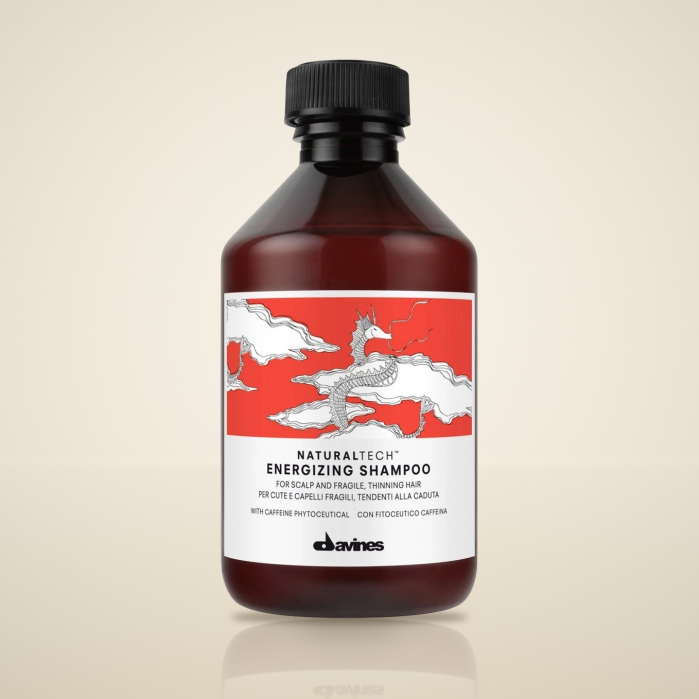
Davines NaturalTech Energizing – for a sensitive scalp and fragile hair
Davines Energizing Shampoo is a sulphate-free, paraben-free formula with caffeine, niacinamide and peppermint and eucalyptus essential oils. It cleanses gently and leaves the scalp feeling fresh. The manufacturer recommends leaving it on for 2–3 minutes, in an intensive phase (every other day for one month) followed by a maintenance phase (twice a week for two months). It's the right choice if you have a sensitive scalp and want a structured routine.
Nyce Ev'ry Density Balance – for daily washing and hair lacking density
Nyce Ev'ry Density Balance Energizing Shampoo is designed for daily use on fragile hair that lacks volume. It contains vegan ceramides and organic ginger extract. Massage it gently into the scalp, leave it for one minute and rinse with lukewarm water. A good fit if you wash often, for example after the gym, and want a shampoo that won't weigh fine hair down.
Londa Professional Vital Booster – the budget-friendly option
Londa Vital Booster Shampoo contains caffeine, menthol and jojoba oil. It quickly refreshes the scalp and prepares it for a leave-in treatment. It's a good option if you want to start on a small budget or simply like the cooling feel of menthol.
In short: sensitive scalp and the patience for a 3-month routine → Davines Energizing; daily washing and fine hair → Nyce Ev'ry Density Balance; tight budget and a fresh feeling → Londa Vital Booster. See every option in our Professional shampoo category.
How to use an anti-hair loss shampoo properly, step by step
- Wet your hair and scalp thoroughly with lukewarm, not hot, water. Very hot water can irritate the scalp.
- Use a small amount (about the size of a coin) in your palms and work it up with a little water.
- Apply it directly to the scalp, section by section, not to the lengths. The lengths get clean enough from the foam that runs down.
- Massage with your fingertips, not your nails, in circular movements for 1–2 minutes.
- Leave the product on for the time shown on the pack (usually 1–3 minutes).
- Rinse very well, then apply conditioner to the lengths and ends only, so you don't weigh down the roots.
- Dry gently: pat with the towel instead of rubbing, and detangle from the ends up to the roots.
For a more complete routine, you can follow your wash with a leave-in lotion such as the Nyce Energy Therapy Lotion ampoules. They stay on the scalp without rinsing and are used as a course: three times a week for one month, then less often for maintenance.
How long before you see a difference
You'll need patience. You'll feel a clean, fresh scalp from the very first wash, but any change in how your hair looks should be judged after at least 8–12 weeks of consistent use. To track your progress fairly, take a photo in the same light at the start and another after three months. If shedding doesn't ease or gets worse during that time, don't keep switching shampoos: book an appointment with a dermatologist.
Mistakes that sabotage any anti-hair loss shampoo
- Scrubbing your scalp with your nails or washing with very hot water. Irritation doesn't help your hair.
- Rinsing straight away. If the formula calls for 2–3 minutes, give it that time.
- Wearing very tight ponytails or buns every day. Constant tension can weaken hair at the root.
- Using straighteners and dryers without heat protection. Broken hairs look like "fallen" ones, even though the real problem is fragility.
- Ignoring diet and sleep. No cosmetic product can make up for a very restrictive diet or chronic stress.
If you notice your hair falls out more in autumn in particular, read our guide to seasonal hair shedding, where we explain what's normal and when it's worth worrying.
Frequently asked questions
Can I use an anti-hair loss shampoo every day?
It depends on the formula. Nyce Ev'ry Density Balance is labelled for daily use, while Davines Energizing has a recommended schedule (every other day, then twice a week). On the days in between, you can use a gentle shampoo that suits your hair type.
Does anti-hair loss shampoo work for men too?
Yes, scalp care products are used the same way regardless of gender. However, gradual thinning at the temples or crown, which is common in men, usually has a hormonal cause and should be assessed by a dermatologist rather than treated with shampoo alone.
Do I still need conditioner if my hair is falling out?
Yes. Conditioner on the lengths makes detangling easier, so you break fewer hairs when combing. Just avoid putting it on the scalp, so you don't weigh down the roots.