
 EN
 Romana
 Français
 Spanish
The right hair mousse can turn fine, flat hair into a style with volume, body and shape that lasts all day. Many people avoid it because they remember the old mousses that left hair stiff, sticky or "crunchy". Today's professional formulas are much lighter: they lift the roots, support curls and almost disappear into the hair once it is dry. In this guide we explain what hair mousse does, how to choose it by hold level and hair type, how to apply it properly step by step, and how the Davines and Wella options in our shop compare.
Hair mousse: what it does and when you need it
Hair mousse, also called styling foam, is a styling product you apply to damp hair before drying. It comes out of the can as an airy foam, spreads easily through the strands and leaves a fine film on them. When you blow-dry, this film "remembers" the shape: the roots stay lifted, the strands look thicker and curls are better defined.
Mousse is especially useful when:
- your hair is fine or thin and falls flat against the scalp soon after styling;
- you want root volume without backcombing;
- your hair is wavy or curly and you want more defined curls with less frizz;
- you do a blow-dry and want the shape to last longer;
- you need a good base for an event style that you then finish with hairspray.
Unlike hairspray, which holds a style that is already done, mousse works before styling: it prepares the hair and gives it structure. Unlike gel, it is lighter and leaves a more natural look, with no wet effect.
How to choose the right hair mousse
The first criterion is the hold level, usually shown on the can as a number or as "flexible", "medium" or "strong".
- Light or flexible hold: for natural volume, fine hair and everyday styles. Hair stays soft and moves freely.
- Medium hold: a good balance for blow-dries and loose waves on normal hair.
- Strong hold: for thick or heavy hair that loses its shape quickly, for curls that need to last and for more elaborate styles.
The second criterion is the main effect. Some mousses are designed purely for volume, others for curl definition, and others add shine or care. If you often use a hairdryer, straightener or curling iron, check whether the mousse also offers heat protection; if not, apply a separate heat protection product.
The third criterion is texture. Very light mousses suit fine hair because they don't weigh it down. Creamier mousses nourish and control dry or curly hair better.
How to apply hair mousse properly, step by step
- Wash your hair and squeeze it well with a towel. Mousse works best on damp hair, not soaking wet hair. If water is dripping, the product gets diluted and the effect drops.
- Shake the can well and hold it upside down when you press the nozzle so the foam comes out evenly.
- Use the right amount: for short hair, a walnut-sized amount; for medium hair, the size of a small egg; for long or thick hair, the size of a tangerine. It is better to start small and add more than to overload your hair from the start.
- Apply to the roots first. Spread the mousse between your palms and run your fingers through your hair, from the scalp towards the lengths. For maximum volume, lift sections and apply product directly at the base.
- Distribute through the lengths with a wide-tooth comb so the mousse reaches all strands evenly.
- Blow-dry your hair, lifting the roots with a round brush or your fingers. For curls, use a diffuser and avoid touching your hair too much until it is dry.
- Finish. If you want the shape to last longer, end with a light mist of hairspray applied from a distance.
In the evening, brush your hair before washing. Professional mousses wash out easily with a regular shampoo.
Professional hair mousse in our shop: a comparison
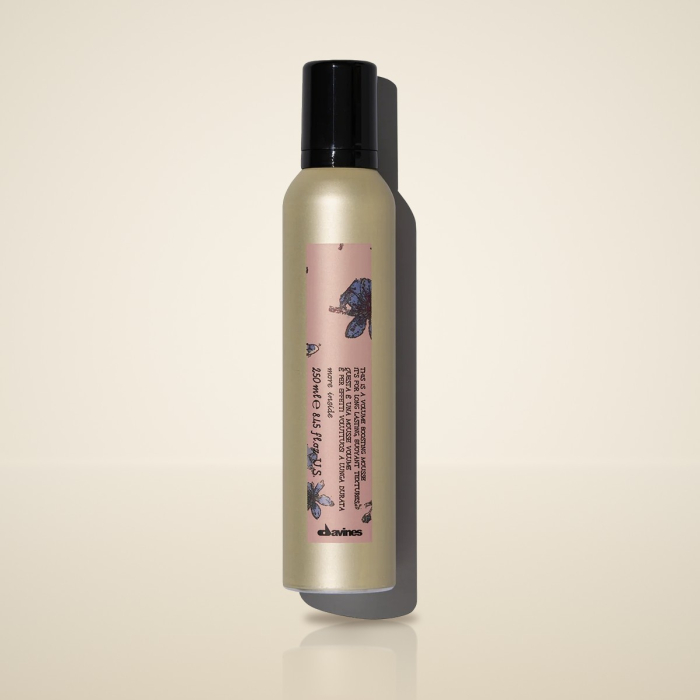
Davines This is a Volume Boosting Mousse 250 ml
Davines This is a Volume Boosting Mousse 250 ml is a creamy mousse with a snow-like texture that gives hair light, natural-looking volume. It suits every hair type and is free of parabens and added colourants. Apply it evenly to towel-dried hair, then style as usual. It is a good choice if you want discreet volume that doesn't look like "product" in your hair.
Davines OI Soufflé 125 ml
Davines OI Soufflé 125 ml starts as a liquid in the bottle and turns into a soft foam as you apply it. It is designed for fine to medium hair: it adds body and shine without weighing it down. It contains the roucou oil from the OI line and, according to the manufacturer, offers heat protection up to 230°C. It is a good fit if you want volume and a glossy, silky look.
Wella Professionals EIMI Natural Volume Mousse 300 ml
Wella Professionals EIMI Natural Volume Mousse 300 ml has a flexible hold (level 2) and gives delicate, refined volume without making hair stiff. Apply it to damp hair from roots to ends, then blow-dry. It suits fine hair that lacks volume and everyday styles.
Wella Professionals EIMI Extra Volume 300 ml
Wella Professionals EIMI Extra Volume 300 ml is a strong-hold mousse for a clear boost of volume. It leaves hair soft and supple, doesn't weigh it down and helps protect the cuticle against dehydration. It suits normal to thick hair that needs support so the volume doesn't drop after a few hours.
- You want natural, discreet volume: Davines Volume Boosting Mousse.
- You want volume plus shine on fine hair: Davines OI Soufflé.
- You want flexible hold at an affordable price: Wella EIMI Natural Volume.
- You want maximum volume and strong hold: Wella EIMI Extra Volume.
You'll find more options, including curl mousses and tinted mousses, in our professional hair mousse category.
Which mousse to choose for your hair type
- Fine or thin hair: a light, flexible-hold mousse applied mainly at the roots. Avoid large amounts, which can flatten your hair. You'll find more ideas in our guide to fine hair without volume.
- Normal hair: a medium-hold mousse for blow-dries and waves that last all day.
- Thick or heavy hair: strong hold and drying with a round brush, so the volume isn't lost under the weight of the strands.
- Wavy or curly hair: a moisturising mousse, scrunched into damp hair and dried with a diffuser, with no brushing after drying.
- Coloured or bleached hair: light formulas without too much alcohol, and a care routine with conditioner and a mask when you wash. For blondes, there are also tinted mousses that help neutralise yellow tones.
Common hair mousse mistakes
- Too much product. Excess leaves hair stiff, sticky or "cardboard-like". Start with a little.
- Applying it to very wet hair. The mousse gets diluted and the volume fades quickly.
- Only on the lengths. For volume, the most important area is the roots.
- Air-drying when you want volume. Mousse works best with the heat and movement of a hairdryer.
- Combining it with too many heavy products. Mousse, lots of oil and wax at the same time can weigh hair down. Choose one main styling product and use the rest only where needed.
Frequently asked questions
Should hair mousse be applied to wet or dry hair?
As a rule, to damp hair that has been squeezed well with a towel, before blow-drying. Some light mousses can also be used on dry hair for touch-ups, but the volume effect is better on damp hair.
Does hair mousse dry out your hair?
A professional mousse used in the right amount shouldn't dry out your hair. If your hair is dry or coloured, choose formulas with caring ingredients, don't overdo the product and keep a routine with conditioner and a mask.
What is the difference between mousse and gel?
Mousse is lighter and gives volume, body and natural definition, with no wet effect. Gel usually has a stronger, more precise hold and is used for more structured styles, clean lines or a wet look.